


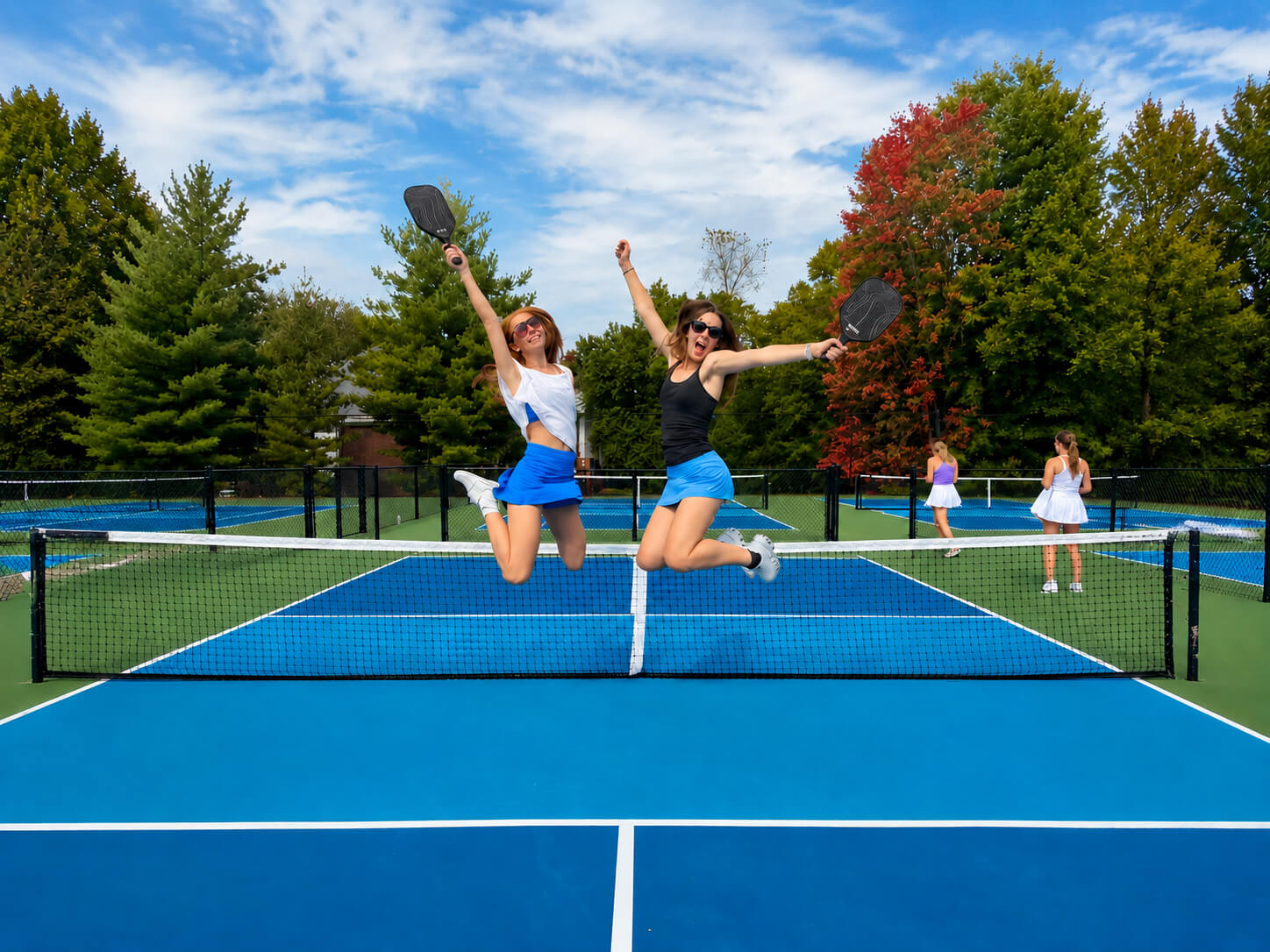
Why Pickleball Doubles Games Are So Much Fun
The best pickleball doubles games combine smart doubles strategy, reliable pickleball teamwork, clear partner communication, and a responsive doubles pickleball paddle.
Picture a ball dropping directly between you and your partner. You both hesitate, each expecting the other to take it, and the ball lands untouched. A few points later, the same shot comes back—but this time, one player calls “Mine,” the other slides over to cover, and the rally continues.
That small adjustment captures what makes doubles so satisfying. You are not only learning how to hit better shots. You are learning how to solve each point with another person.
Every Rally Is a Shared Puzzle
Singles pickleball asks one player to cover the entire court. Doubles creates a different challenge: two players must share space without getting in each other’s way.
During each rally, you and your partner are constantly making small decisions:
- Who should take the ball down the middle?
- Should both players move toward the Kitchen?
- Who covers the open court after a wide shot?
- Should you attack the next ball or reset the rally?
- Who retrieves a lob?
- Is your partner ready for a faster exchange?
These decisions happen quickly. When both players read the point the same way, the game feels smooth and connected. When they do not, even an easy ball can create confusion.
That shared problem-solving is a major part of the fun.
Agree on Responsibilities Before the Game
Good doubles play often begins before the first serve.
Spend a minute discussing how you will handle common situations. You do not need an advanced tactical plan, but a few simple agreements can prevent hesitation.
Consider discussing:
- Who takes most balls down the middle
- Whether the forehand or stronger player has priority
- Who retrieves a lob over either player
- How you will switch sides after being pulled wide
- Whether you prefer aggressive attacks or patient resets
- How loudly and frequently you want to communicate
These agreements are not permanent rules. They simply give both players a starting point.
If your partner moves differently than expected, adjust during the game rather than silently becoming frustrated.
Move Forward and Back as a Team
One of the most common doubles problems occurs when one player reaches the Kitchen line while the other remains near the baseline.
This staggered formation creates a large gap that opponents can target. The forward player may also receive a fast ball before the partner is ready to cover the next shot.
Think of you and your partner as being connected by a short rope. You do not need to stand at exactly the same depth, but your movement should remain coordinated.
When one player moves forward, the other should look for an opportunity to join. When one player is forced backward by a lob, both players may need to reset their positions.
USA Pickleball’s official doubles strategy tips emphasize advancing toward the Kitchen together, serving and returning deep, using patient dinks, and playing high-percentage shots through the middle.
Moving as a unit reduces open space and makes it easier to defend fast exchanges.
Use Short, Clear Calls
Effective partner communication does not require long conversations during a rally.
Use short calls that your partner can understand immediately:
- “Mine” — You are taking the shot.
- “Yours” — Your partner should play it.
- “Out” — Let the ball go because you expect it to land outside.
- “Bounce” — Let the ball bounce if you are uncertain about its path.
- “Switch” — Change sides after one player is pulled across the court.
- “Stay” — Hold the current formation.
- “Go” — Move forward when both players have an opportunity to advance.
Make calls early and confidently. A late “Yours” is rarely useful when the ball is already bouncing between you.
USA Pickleball’s guide to essential pickleball fundamentals also recommends communicating about middle balls, lobs, out balls and strategy between points.
Communication should clarify the rally—not become a running commentary on every mistake.
Find a Partner With a Compatible Rhythm
You and your partner do not need identical ratings or playing styles. In fact, different strengths can create an effective team.
A patient control player may work well with an aggressive attacker. One player may be comfortable covering lobs, while the other reacts quickly during hand battles at the Kitchen.
What matters most is whether your expectations are compatible.
Ask yourself:
- Are you both playing casually or trying to compete?
- Do you prefer patient rallies or fast attacks?
- Are you comfortable receiving feedback during a match?
- How do you respond after losing several points?
- Do you encourage each other or assign blame?
A technically skilled partnership can still feel uncomfortable if the players approach the game differently. A less experienced pair with good chemistry may have more fun and improve faster.
Support Your Partner After Mistakes
Every doubles player misses easy shots, leaves a ball high or makes a poor line call.
Strong partners recover quickly. Instead of analyzing the mistake during the next rally, use a short response such as:
- “We’re good.”
- “Next point.”
- “Right idea.”
- “I’ve got the middle.”
- “Let’s slow it down.”
Encouragement is not merely social courtesy. It helps both players stay focused on the next decision.
When you make a mistake, acknowledge it briefly and move on. Repeated apologies can create more tension than the original error.
Choose Equipment for Fast Doubles Exchanges
Doubles rallies often include blocks, counters and quick hand battles near the Kitchen. A paddle that feels stable and responsive can help players manage these faster exchanges.
When choosing a doubles pickleball paddle, consider:
- Maneuverability during quick volleys
- Stability against harder incoming shots
- A comfortable, secure grip
- A forgiving sweet spot
- Predictable control during resets and dinks
- Enough power to finish attackable balls
Paddle weight and balance also matter. A very heavy paddle may feel stable but become tiring during rapid exchanges. An extremely light paddle may move quickly but provide less stability against powerful drives.
The Onyx 16mm Pickleball Paddle for Power and Control uses a thermoformed carbon-fiber construction and polypropylene core designed for responsive defense, quick counters and stable handling during faster play.
The right paddle should complement your reactions and playing style. It cannot replace communication or positioning, but it can make executing your decisions more comfortable.
Develop Simple Patterns Together
You do not need a complicated playbook. Start with two or three repeatable patterns.
Deep Return, Then Move Forward
Send the return deep to give the returning team more time to establish position near the Kitchen.
Third-Shot Drop, Then Advance Together
Use a controlled drop to create time for both partners to move forward. Avoid rushing into the transition zone behind a high ball.
Play Through the Middle
A shot through the center can reduce your opponents’ attacking angles and force them to decide who should take the ball.
Reset When the Attack Is Not Available
Not every ball should be driven. If you receive a low or difficult shot, soften the return and rebuild the point.
Simple patterns give both partners a shared expectation. That makes movement more coordinated and reduces rushed decisions.
The Social Side Still Matters
Doubles naturally gives four people opportunities to talk, rotate partners and learn from one another.
A regular game can become a weekly routine with friends, a way to meet players at a local court or an easy activity for family gatherings. Our guide to playing pickleball with friends and building a social sports community explores why that combination of movement and connection keeps players coming back.
Competitive goals and social enjoyment do not have to be opposites. You can play seriously during the rally and still laugh about an awkward miss afterward.
A Quick Pregame Conversation
Before your next doubles match, ask your partner five questions:
- Who takes the middle ball?
- Who retrieves most lobs?
- What call should we use when switching?
- Do we want to attack early or play patiently?
- What should we adjust if the first plan does not work?
That brief conversation can prevent several points of confusion.
Keep the Partnership Enjoyable
A good doubles game is not defined only by the final score.
It is the moment when both players move forward together without needing to discuss it. It is the early call that prevents a collision, the reset that saves a difficult point and the encouragement that helps a partner recover after a mistake.
Whether you are preparing for a tournament or playing a weekend match, focus on making decisions together. Communicate clearly, stay connected on the court and give each other room to improve.
Winning a point feels good. Winning it because you and your partner understood each other feels even better.
FAQ
Doubles can be a comfortable way to learn because you have a partner on the court. Players can gradually develop communication, positioning, and shot skills through regular games.
Yes. Players with different skill levels can enjoy doubles together, especially in recreational games.
A responsive and well-balanced paddle can be useful for doubles because players often need quick reactions and good control during fast exchanges.


