


Honeycomb vs. EPP Foam Pickleball Paddle Cores: What’s the Difference?
Comparing pickleball paddle cores helps you understand what sits behind the hitting surface. A honeycomb core and an EPP foam core use different internal structures, which can influence impact feel, paddle control, and paddle power. However, neither core type determines performance on its own.
For everyday players, the useful question is how the complete paddle responds during serves, rallies, blocks, and soft shots. Here is what to know before choosing.
What Is a Honeycomb Pickleball Paddle Core?
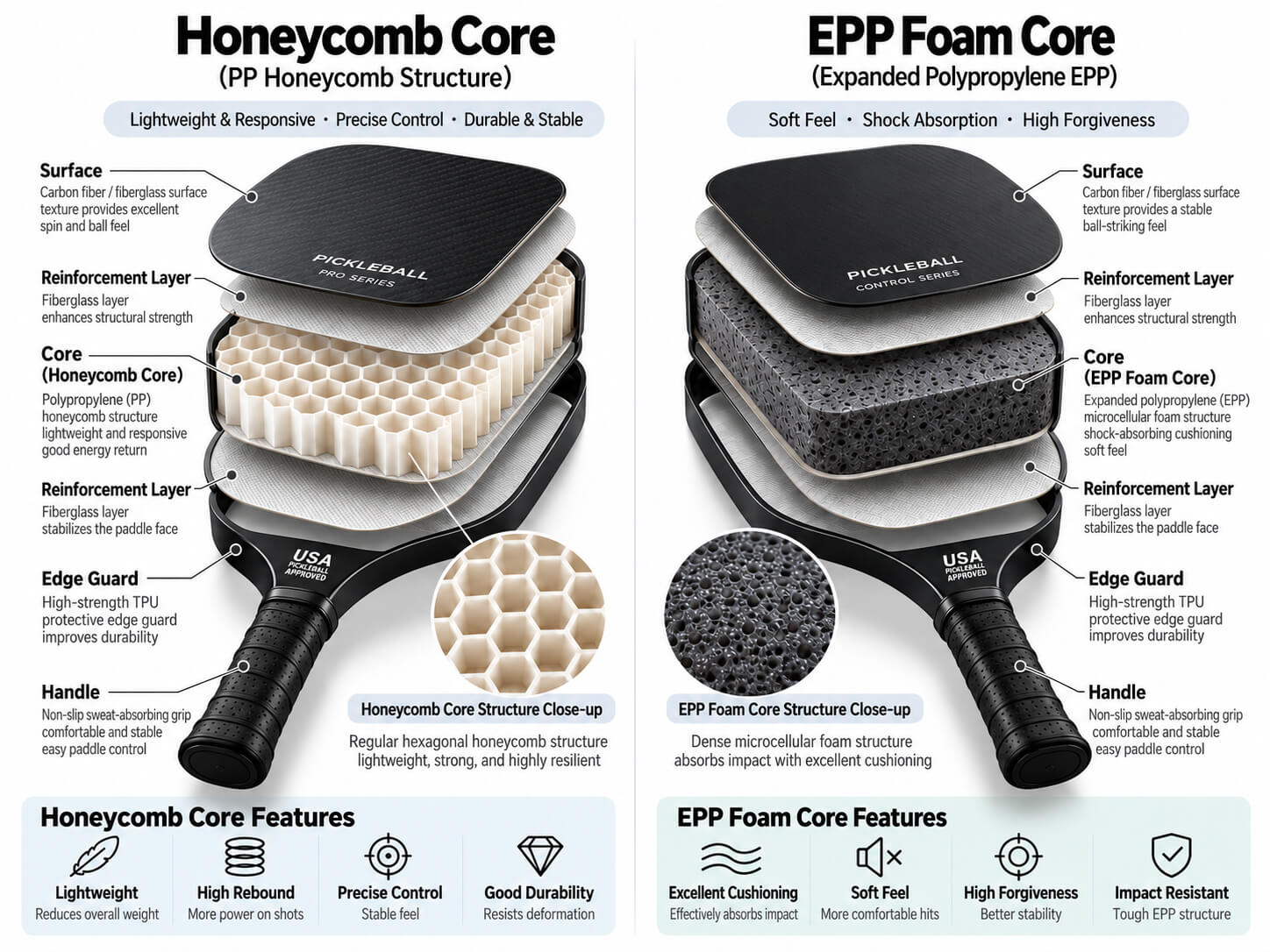
A polypropylene honeycomb core contains a network of hollow cells positioned between the paddle’s two face sheets. This structure provides support while limiting the amount of material needed.
Corex Honeycomb’s overview of polypropylene honeycomb explains how this material is used in lightweight sandwich structures. That helps explain the construction principle, although material properties alone do not establish how a finished paddle will play.
Honeycomb paddles can be designed for different playing preferences. Core thickness, cell dimensions, face materials, and perimeter reinforcement all contribute to the final result.
Some models feel crisp and direct. Others offer a softer response suited to controlled placement. “Honeycomb” describes the internal structure, rather than a single playing style.
What Is an EPP Foam Pickleball Paddle Core?
EPP stands for expanded polypropylene. It uses a foam structure rather than the larger hollow cells found in a conventional honeycomb core.
As described in Engineered Foam Products’ guide to expanded polypropylene, EPP is a closed-cell foam made from expanded beads that can be fused into blocks or molded shapes. It is available in different densities and has cushioning and impact-absorption properties.
Those characteristics give paddle designers another way to develop the core. However, a foam material’s cushioning properties do not automatically make the finished paddle soft, slow, or more forgiving.
Density, geometry, face stiffness, bonding, and surrounding support still matter. An EPP foam core may also be combined with other materials, so it is worth checking what the manufacturer means by “foam core.”
Honeycomb vs. EPP Foam at a Glance
Both options can use polypropylene as their underlying material. The main distinction is how that material is structured.
| Feature | Polypropylene honeycomb core | EPP foam core |
| Internal structure | Network of hollow cells | Expanded foam containing small closed cells |
| Design variables | Cell dimensions, wall thickness, core thickness, and reinforcement | Foam density, molded geometry, core thickness, and reinforcement |
| Contact feel | Can range from crisp to cushioned | Can range from cushioned to firm and lively |
| Power and control | Depend on the complete paddle | Depend on the complete paddle |
| What to compare | Response, stability, weight, and comfort during play | Response, stability, weight, and comfort during play |
A simple “honeycomb for power, foam for control” rule misses too much of the design. The reverse is equally unreliable.
Why the Face and Frame Still Matter
The core works together with the face sheets, frame, handle, and overall weight distribution.
When comparing two paddles, look beyond the core label:
- Face construction: Consider the material, layering, and surface treatment.
- Thickness: Compare it alongside core density and structure.
- Weight and balance: Check how easily you can prepare and move the paddle.
- Frame construction: Pay attention to stability during off-center contact.
- Grip dimensions: Make sure the handle feels comfortable and secure.
Our guide to fiberglass vs. carbon fiber pickleball paddles introduces another part of this comparison: the face material used around the core.
A Honeycomb Paddle Example
The FISTO Swift T700 Carbon Fiber Pickleball Paddle combines a 16mm polypropylene honeycomb core with a T700 carbon fiber face, hot-pressed construction, full-edge protection, and a PU grip. Its listed specifications also include a 14cm handle and a weight of 250 ± 10 grams.
This illustrates why the complete specification matters. Core material is one part of the comparison; weight, handle dimensions, and construction also deserve attention when evaluating handling and comfort.
Which Core Should You Choose for Everyday Play?
Start with the response you want, then test individual paddles.
During a demo session, try:
- Dinks and drops: Can you place the ball consistently?
- Blocks and resets: Can you manage incoming pace?
- Drives and serves: Does the response feel predictable?
- Fast volleys: Can you prepare the paddle comfortably?
- Off-center shots: Does the paddle remain stable in your hand?
Where possible, compare models with similar weight, shape, and thickness. This makes differences in construction easier to assess.
For brands and distributors, offering both core options can support a broader product range. Define the intended player and desired response first, then compare samples for consistency, durability, and playing feel.
The better choice is the paddle that gives you comfortable handling and repeatable results across the shots you actually play.
FAQ
Not necessarily. Both have different structural characteristics, but control, power, and comfort depend on core design, thickness, face material, weight distribution, and playing technique.
There is no universal winner. Intermediate players should consider their playing style, preferred paddle feel, control needs, and shot consistency. Comparing paddles with similar weights and face materials can help reveal the differences between core designs.
Yes. Core thickness can influence paddle stiffness, feel, and shot response. Thicker paddles may offer a different balance of control and power, but the final performance also depends on paddle weight, face material, and construction.


