


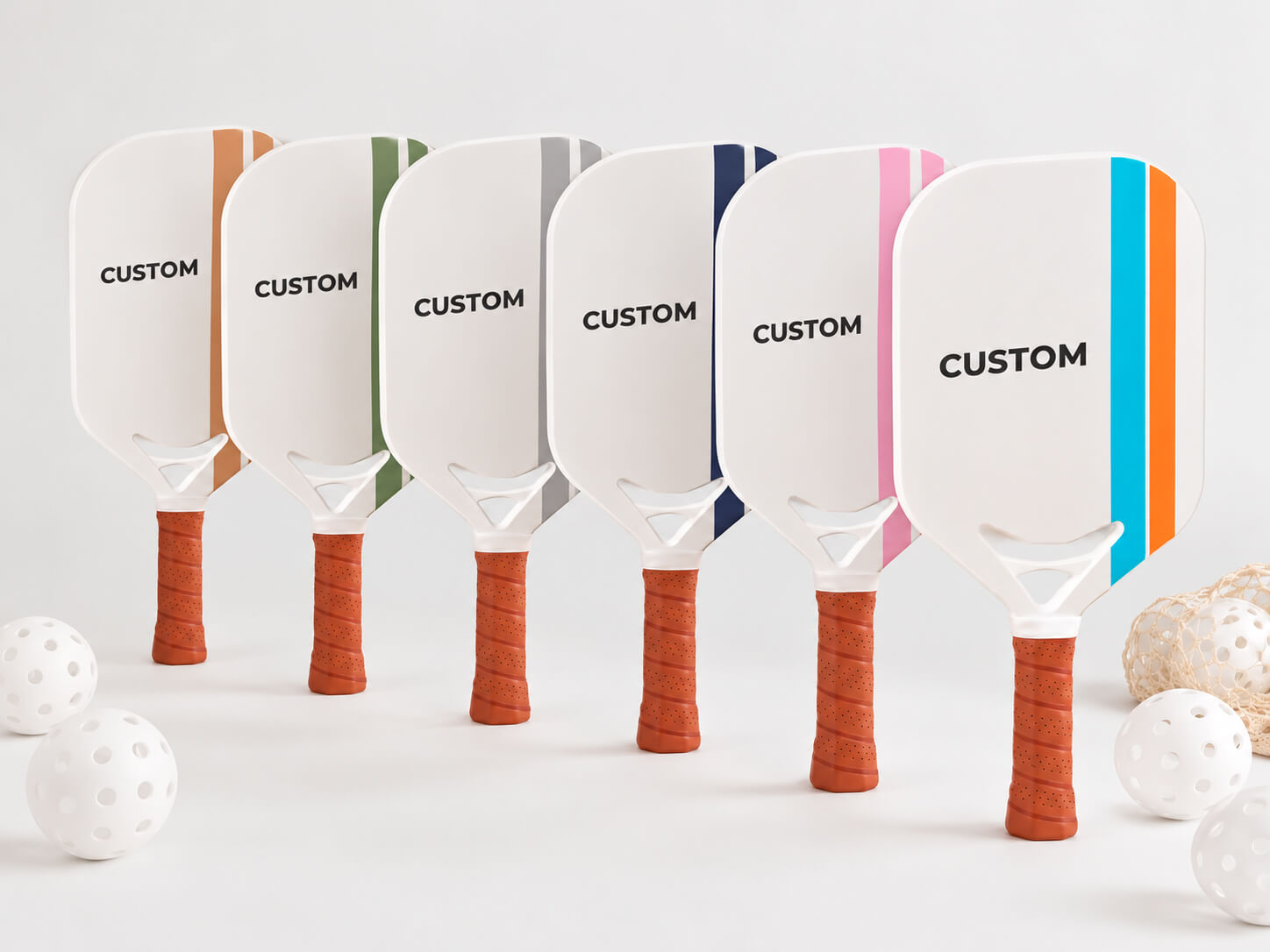
Custom Pickleball Paddles: What Can You Customize?
Custom pickleball paddles give sports brands, retailers, and clubs a way to create equipment with a recognizable identity. When developing private label pickleball paddles, your options may include custom paddle design, different paddle materials, and branded packaging—depending on the supplier’s capabilities and your order requirements.
You do not always need to develop a completely new paddle. An existing construction with your graphics and packaging can be a practical starting point. More extensive changes to shape, materials, and structure require additional development and sample evaluation.
Here is what to discuss before placing your first order.
1. Paddle Shape and Dimensions
Start with the intended player and the purpose of the product.
An elongated design may appeal to players who want additional reach. A wider face provides a broader hitting area, while a standard shape can offer familiar proportions for recreational use.
Ask your supplier which existing shapes are available and which changes would require new tooling. Confirm the overall length, width, handle dimensions, and target weight together, since changing one feature can affect the others.
If the paddle is intended for sanctioned competition, include the applicable equipment requirements in the initial design brief.
2. Face Materials and Core Construction
Material selection should support your intended playing experience and price range.
| Component | Options to discuss | What to confirm |
| Paddle face | Carbon fiber, fiberglass, or combined layers | Material specification, layer arrangement, and finish |
| Core | Polypropylene honeycomb, EPP foam, or other available structures | Core material, thickness, density, and construction |
| Perimeter | Edge guards or reinforced edge structures | Material, attachment method, and finish |
| Grip | Different wraps, textures, and cushioning | Circumference, comfort, and replacement options |
These components work together. A carbon fiber face alone does not establish how much power, control, or spin a finished paddle will produce.
For an example of an existing construction, the FISTO 10mm Fiberglass Pickleball Paddle for Beginners lists a fiberglass face, polypropylene honeycomb core, cold-pressed construction, and TPU edge protection. The product page also offers customization of logos, graphics, colors, materials, and packaging for wholesale projects.
A model like this can provide a starting point for a recreational product range. Confirm which modifications are available for your quantity and budget before approving a design.
3. Colors, Graphics, and Logo Placement
Visual customization can help distinguish your paddle without requiring a new structural design.
Depending on the model, options may include:
- Brand logos and model names
- Custom artwork on both faces
- Coordinated grip and edge-guard colors
- Different colorways within one product family
- Printed product identifiers
Request the supplier’s artwork template before preparing graphics. Confirm printable areas, color references, logo dimensions, and how the artwork will appear on the selected surface.
Review a physical sample as well as a digital proof. Printed colors, fine details, and surface finishes can look different from a screen mockup.
For competition-oriented products, plan approval requirements alongside the artwork. The USA Pickleball equipment submission FAQ states that submitted paddles must display final graphics, including the manufacturer’s name and model name on the face. It also describes a separate similarity-submission process, so an existing construction should not be treated as automatic approval for a newly branded model.
4. Thickness, Weight, Grip, and Handle Design
A customized paddle should feel appropriate for its intended users.
Discuss core thickness, total weight, balance, handle length, and grip circumference as a complete specification. For example, a longer handle may accommodate a preferred hand position, but it also changes the paddle’s proportions.
Ask the supplier to document target measurements and acceptable production tolerances. Then evaluate samples for:
- Comfortable grip and handle fit
- Manageable swing weight and balance
- Consistent response during different shots
- Secure edge and handle construction
- Uniform finish across multiple samples
Use player feedback to refine the specification before committing to bulk production.
5. Branded Packaging and Accessories
Packaging should protect the paddle and clearly explain what customers are buying.
Options to discuss include retail boxes, protective covers, hang tags, care cards, and coordinated accessories. Decide whether the paddle will be sold individually or as part of a set, since this affects packaging dimensions and product information.
For retail distribution, reserve space for the barcode early in the design process. The GS1 US barcode placement and printing guidelines explain why readable artwork, suitable contrast, clear space, and correct placement matter for reliable scanning.
Check a finished packaging sample for paddle fit, print quality, and protection during handling. Make sure the specifications printed on the box match the approved product.
6. Define the Scope of Your Custom Order
Terms such as private label, OEM, and ODM can describe different arrangements between suppliers. Specify the work you need instead of relying on the label alone.
| Project scope | Typical work to discuss |
| Branding an existing model | Graphics, logos, colors, and packaging |
| Modifying an existing model | Available material, grip, thickness, or handle changes |
| Developing a new model | Shape development, tooling, structural design, and testing |
FISTO’s OEM and ODM services provide a starting point for discussing custom sports equipment projects and development requirements. Share your intended customer, product specifications, estimated quantity, and launch schedule so the proposed scope can be reviewed.
A Practical Way to Start Your First Order
Begin with one or two constructions that match your target customers. Customize the graphics and packaging, evaluate samples, and expand the range after gathering feedback.
Before confirming the order, agree on:
- Product specifications: Materials, dimensions, weight range, and finish.
- Artwork: Final files, color references, and logo placement.
- Order quantities: Minimums for each model, colorway, and packaging version.
- Costs: Sampling, tooling, printing setup, packaging, and production.
- Timing: Sample approval, manufacturing, inspection, and shipping.
- Quality criteria: The approved reference sample and inspection requirements.
A clear specification gives both buyer and supplier a shared reference. It also helps keep the paddle, packaging, and product claims consistent as your private-label range develops.
FAQ
Common options include shape, face material, core, thickness, color, logo, grip, handle, edge guard, and packaging. The available options depend on the manufacturer’s production capabilities and the selected model.
Yes, but customization does not automatically make a paddle tournament-approved. According to the USA Pickleball Equipment Standards Manual, equipment used in sanctioned tournaments must meet the applicable specifications and appear on the approved paddle list. Confirm approval for the exact model and version.
For many new brands, customizing the appearance of an existing construction is a practical first step. If your brand needs a distinct playing feel or technical positioning, material and structural development may deserve more attention.


