


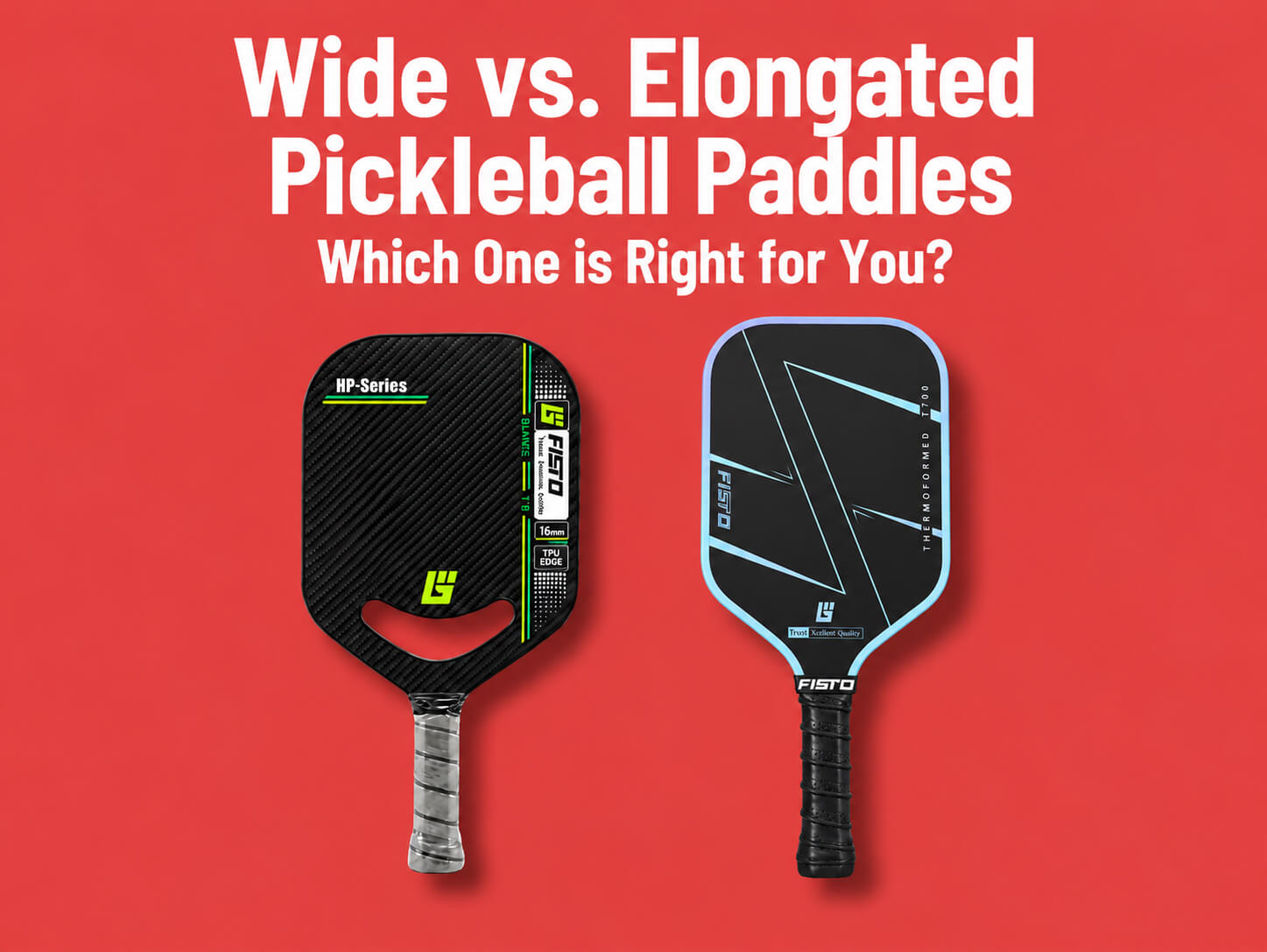
Widebody vs. Elongated Pickleball Paddles: Which Shape Fits Your Game?
A widebody pickleball paddle offers a broader face, while an elongated pickleball paddle trades some width for additional length and reach. When comparing pickleball paddle shapes, consider the paddle sweet spot, paddle swing weight, and handle dimensions alongside the outline.
Which should you try first? Start with a widebody if you prioritize face width and forgiveness. Try an elongated design if extra reach matters more. Neither shape automatically delivers better power or control—the complete paddle and your technique determine the result.
Widebody vs. Elongated Paddles at a Glance
| Feature | Widebody paddle | Elongated paddle |
| General proportions | Broader face and shorter overall profile | Longer, narrower profile |
| Main reason to consider it | More face width for making contact | Additional reach |
| Off-center response | May offer greater forgiveness, depending on construction | Depends on reinforcement and weight distribution |
| Handling | Can feel compact during quick exchanges | May require more effort to reposition if swing weight is higher |
| Two-handed backhand | Possible with sufficient handle length | Possible with sufficient handle length |
| Useful starting point for | Players prioritizing contact consistency | Players prioritizing reach |
These are comparison guidelines, not fixed performance ratings. Check the actual dimensions and specifications of each model.
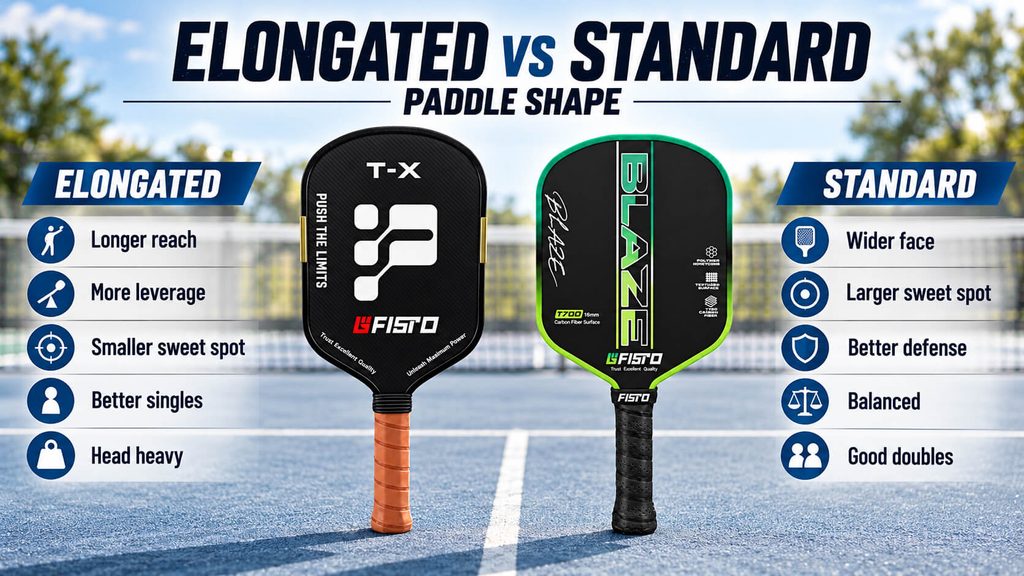
What Is a Widebody Pickleball Paddle?
A widebody paddle has a relatively broad hitting face and compact proportions. The additional width gives you more lateral space to contact the ball, which may feel reassuring during fast volleys or defensive blocks.
A wider face and a larger sweet spot are related ideas, but they are not interchangeable. The sweet spot describes the area where contact feels most effective and consistent; it is influenced by construction as well as geometry.
In its overview of widebody and elongated paddle designs, Selkirk emphasizes forgiveness and stability for its widebody models and additional reach for its elongated models. Those descriptions apply to the company’s designs rather than establishing a universal rule for every paddle.
A widebody is worth testing if you frequently miss toward the sides of the face or want a comfortable starting point for doubles exchanges.
What Is an Elongated Pickleball Paddle?
An elongated paddle uses a longer, narrower outline. The added length can help when reaching for a passing shot, stretching for a volley, or covering an angle.
However, overall paddle length and handle length are different measurements. A longer paddle may allocate extra space to the face rather than the grip.
The JOOLA paddle selection guide illustrates this distinction: its elongated Magnus design uses a shorter handle and longer face. If you play a two-handed backhand, compare usable handle space instead of assuming every elongated paddle accommodates both hands.
An elongated shape may suit you if reach is a recurring concern. During a demo, also check whether you can recover comfortably after a full swing.
How Do Sweet Spot and Swing Weight Affect the Choice?
Two paddles can have similar dimensions and listed weights yet feel different in motion.
Paddle swing weight describes resistance to swinging around a reference axis. Weight placed farther from your hand can make a paddle feel more demanding to accelerate and reposition, even when its total weight is familiar.
The paddle sweet spot concerns contact quality across the face. A paddle that feels stable on a slightly off-center block may be more useful to you than one that feels excellent only when contact is perfectly centered.
During testing, ask:
- Can I get the paddle into position before the ball arrives?
- Does the face remain stable when I miss the center?
- Can I control both soft shots and firm drives?
- Does handling remain comfortable after several games?
Shape helps narrow the search, but these observations help determine the fit.
Which Shape Is Better for Beginners?
A widebody is a sensible first shape to try because its broader face gives beginners more width for making contact. It is not a requirement.
A beginner with tennis experience may feel comfortable with a longer profile. Another player may prefer a compact paddle for quick exchanges. Grip comfort, manageable swing weight, and predictable ball response deserve as much attention as shape.
Choose the paddle that lets you repeat basic shots comfortably. An advanced player’s preferred model may solve a different set of problems from yours.
Does Shape Matter More Than Core or Face Material?
There is no useful universal ranking. Shape, face construction, core design, thickness, and weight distribution work together.
A widebody carbon fiber paddle can feel different from an elongated carbon fiber model. Even two paddles with matching shape and thickness can respond differently if their internal structures differ.
Our comparison of honeycomb and EPP foam pickleball paddle cores explains why core structure should be evaluated alongside face construction, weight, and overall design.
Where possible, compare shapes within the same product family, with similar materials and thickness. This reduces—but does not eliminate—the number of other differences influencing your impression.
Check Actual Dimensions Before Buying
Shape labels are a starting point. Published measurements make the comparison more concrete.
For example, the FISTO Zest 16mm Pickleball Paddle for Beginners and Recreational Players lists dimensions of 40 × 19.5 cm, a 12 cm handle, and a weight of 220 ± 10 grams. It combines a fiberglass face with a polypropylene honeycomb core.
Use those measurements as reference points when comparing a longer or wider alternative. Dimensions alone cannot establish sweet-spot size or handling, so follow the specification comparison with a sample test.
A Simple On-Court Comparison
Use the same ball and a similar practice sequence with each paddle:
- Dinks: Check whether you can repeat depth and placement.
- Blocks and resets: Notice stability and control against incoming pace.
- Fast volleys: Assess how comfortably you reposition the paddle.
- Serves and drives: Compare timing and consistency.
- Reach shots: Decide whether the extra length provides a useful benefit.
Record your impressions before switching paddles. Specific observations—such as “easier to prepare on backhand volleys”—are more useful than simply labeling a paddle powerful or forgiving.
Frequently Asked Questions
Does a widebody paddle always have a bigger sweet spot?
No. A wider face provides more lateral hitting area, but the usable sweet spot also depends on the core, face construction, reinforcement, and weight distribution.
Are elongated paddles only for advanced players?
No. Players at different skill levels can use elongated paddles. Comfortable handling and consistent contact matter more than the skill label attached to a shape.
Do I need an elongated paddle for a two-handed backhand?
No. Handle length and grip fit are the relevant checks. Both widebody and elongated designs can accommodate two hands when the handle provides enough space.
FAQ
Not automatically. Extra length can influence leverage and swing characteristics, but power also depends on paddle weight, swing weight, stiffness, core construction, and the player’s technique.
A widebody can appeal to doubles players who prioritize quick reactions and a broad contact area near the kitchen line. An elongated paddle can appeal to players who want additional reach. Neither is universally better; balance and swing weight are especially important for quick exchanges.
Yes. Shape is only one part of paddle design. Materials, core construction, thickness, weight distribution, and handle length can all change how a paddle feels. A practical comparison should consider these factors together rather than relying on the shape name alone.


